
Your warehouse is overflowing. Inventory is creeping into your office. Employees are squeezing around boxes to get to their desks. Delivery trucks are backing up because there’s nowhere to unload. You’re turning away orders because you literally have nowhere to put the stock.
This wasn’t supposed to happen. Flex space is designed to help businesses grow—but every space has its limits. Somewhere along the way, your flexible warehouse stopped feeling flexible. It started feeling like a constraint.
If this sounds familiar, you’re not alone. Businesses outgrow flex space all the time—it’s actually a sign you’ve succeeded. But the question isn’t just “have we outgrown flex space?” It’s “is our current space slowing us down?”
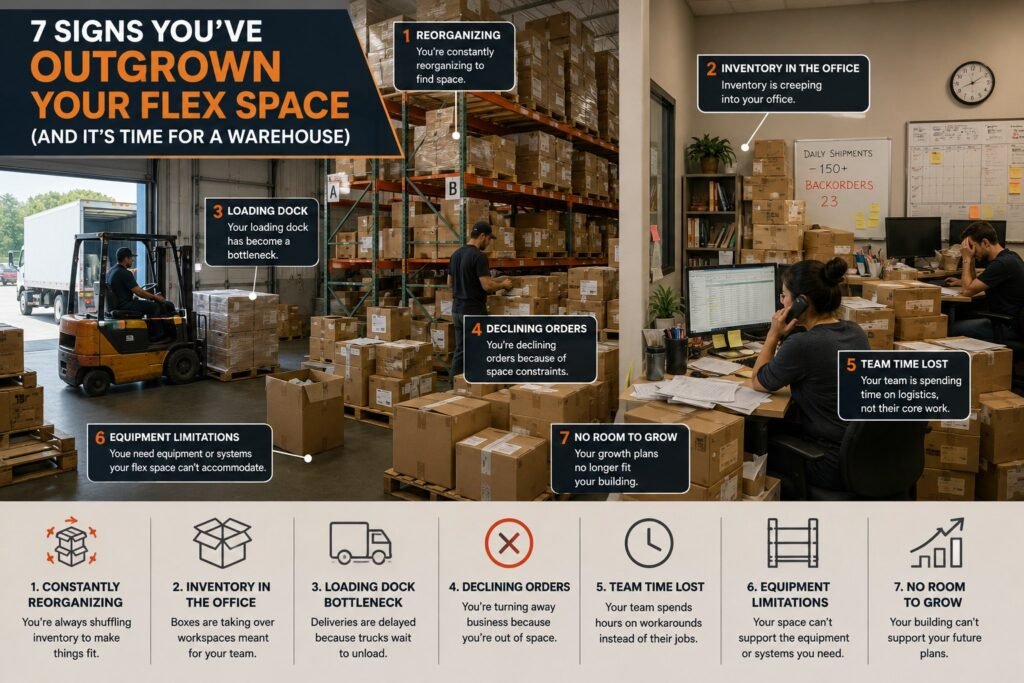
Not every growing business needs a warehouse—but if you’re experiencing several of the warning signs below, it may be time to start planning for one.
7 Signs You’ve Outgrown Your Flex Space
1. You’re constantly reorganizing to find space.
You’re reshuffling inventory weekly just to fit everything. Pallets are stacked higher than they should be. You’re moving slow-moving inventory to corners and forgetting about it. This isn’t optimization—it’s a sign you’ve run out of room and you’re making it work anyway. That costs time and money.
2. Inventory is creeping into your office.
Your office space is shrinking. There are boxes under desks, in corners, sometimes in hallways. Your team is losing workspace, and it’s affecting how people work. This is the clearest sign: when your operations are literally taking over your administrative space, you need more room.
3. Your loading dock has become a bottleneck.
Incoming and outgoing shipments are getting held up. Trucks are waiting to unload because the dock is backed up. In a shared flex building, you’re competing with other tenants for dock time. Deliveries take much longer than they should because trucks are waiting for dock access. This slows down your whole operation.
4. You’re declining orders because of space constraints.
You’ve actually said “no” to business because you don’t have room to store it or fulfill it. This is the moment it stops being inconvenient and starts costing you revenue. If you’re leaving money on the table because of space, it’s definitely time to think about moving.
5. Your team is spending time on logistics instead of their core job.
Warehouse staff are spending hours finding products, reorganizing to make room, or managing around space limitations. Your office team is dealing with the fallout—customer service answering questions about delays, management coordinating workarounds. People are working harder to accomplish less.
6. You need equipment or systems that your flex space can’t accommodate.
You want to add conveyor systems, pallet racks, automated equipment, or specialized climate control—but your flex lease doesn’t allow major modifications. You’re working around what the building allows instead of designing the space around your operation. This compounds over time.
7. Your growth plans no longer fit your building.
You’re hiring, adding inventory, or expanding operations, but your current building has no room to grow. Instead of planning for the future, you’re constantly trying to squeeze more into the same space. You’re designing your business around your lease instead of designing your space around your business.
Not sure how much space your business actually needs? Use our Flex Space Calculator before comparing warehouse options.
Real-World Example
Imagine an e-commerce company that started with three employees shipping 20 orders a day from a 3,000-square-foot flex unit. Three years later they’re shipping 300 orders a day, hiring warehouse staff, and storing inventory in the office break room. The building hasn’t changed—but the business has. That’s when it’s time to evaluate a dedicated warehouse.
Why Most Businesses Start in Flex Space
Most businesses don’t start in a dedicated warehouse because they don’t need one yet. Flex space offers lower commitment, lower risk, and enough room to grow while a business is still finding its footing. Outgrowing flex space isn’t a mistake—it’s often a sign your business has reached its next stage.
When a Warehouse Makes More Sense
A dedicated warehouse makes sense when your operation has stabilized and your space needs are predictable.
You’re no longer figuring out your business model. You’ve found product-market fit. Your operations are consistent month-to-month. Growth is steady but not chaotic. A warehouse commitment won’t trap you in an outdated setup because your setup isn’t changing every quarter.
Your growth projections extend beyond what flex space can provide. You’re planning 3-5 years ahead and you know you’ll need more space. A warehouse can be sized for that growth. You can stop worrying about outgrowing again soon.
You need operational control. You want to design your space around your workflow, not fit your workflow around the space. A warehouse lets you customize layouts, access, equipment, and infrastructure to match your actual operation.
In many cases, the economics start to shift. At higher volumes, dedicated warehouse rent often becomes competitive with flex space costs—especially once you factor in all the add-ons and inefficiencies of flex space constraints.
When NOT to Move Yet
Don’t move to a warehouse if:
* Your growth is seasonal and you can’t predict your long-term needs.
* You’re still experimenting with your business model and operations are changing frequently.
* You expect to relocate to a different city or region within the next year.
If any of these apply, flex space flexibility is worth the extra cost.
Common Mistakes to Avoid
Don’t commit to a space that’s “perfect for now.” Buy room for growth. Your projections are probably conservative. A space sized exactly for today will be tight in two years.
Don’t ignore the operational cost of ownership. In flex space, the landlord handles maintenance, utilities, and facility management. In a dedicated warehouse, some of that falls on you. Budget for it.
Don’t negotiate blindly. If you move to a warehouse, bring in someone experienced. Real estate deals have a lot of moving parts, and small oversights get expensive fast.
FAQ
How much warehouse space do I need?
Use the Flex Space Calculator to estimate square footage based on your employee count, inventory volume, and equipment. Consider allowing additional space for future growth so you don’t outgrow your new facility too quickly.
Can I lease a warehouse instead of buying?
Yes. Most businesses lease warehouse space rather than buy. Leasing avoids large upfront capital costs, preserves cash flow, and keeps you flexible if your needs change.
Is it better to expand my current flex space?
If your flex building has available space and you can modify it to your needs, it might be faster than moving. But if you’re constrained by shared tenants, outdated infrastructure, or landlord restrictions, a dedicated warehouse designed for your operation is usually the better choice.
How long are warehouse leases?
Warehouse leases are generally longer than flex space leases, often ranging from three to five years. Lease terms vary by landlord, property, and market.
What’s the difference between flex space and a warehouse?
Flex space is a hybrid—warehouse or operational space combined with a built-in office. A pure warehouse is just storage. For a detailed comparison, see our Flex Space vs. Warehouse guide.
The best space isn’t the biggest space—it’s the one that supports your business today while leaving room for tomorrow.
Continue Planning Your Space
Flex Space Calculator – Estimate your square footage needs based on employee count and inventory requirements
Office Space Planning Guide – Detailed walkthrough of choosing between warehouse and office space
What Is Flex Space? – Broader overview of flex space options