
Trying to decide between flex space and coworking? While the terms are often used interchangeably, they describe different types of workspaces. The right choice depends on your team size, privacy needs, budget, and growth plans.
Here’s a clear breakdown of what separates flex space from coworking, and how to decide which one fits your needs.
The quick answer
Coworking is a type of flex space. But not all flex space is coworking. Think of it like this: coworking is a subset of the broader flex space category. Flex space is the umbrella term for any commercial real estate that offers flexible lease terms and adaptable layouts. Coworking is one specific version of that — defined by shared, open environments where multiple companies work side by side.
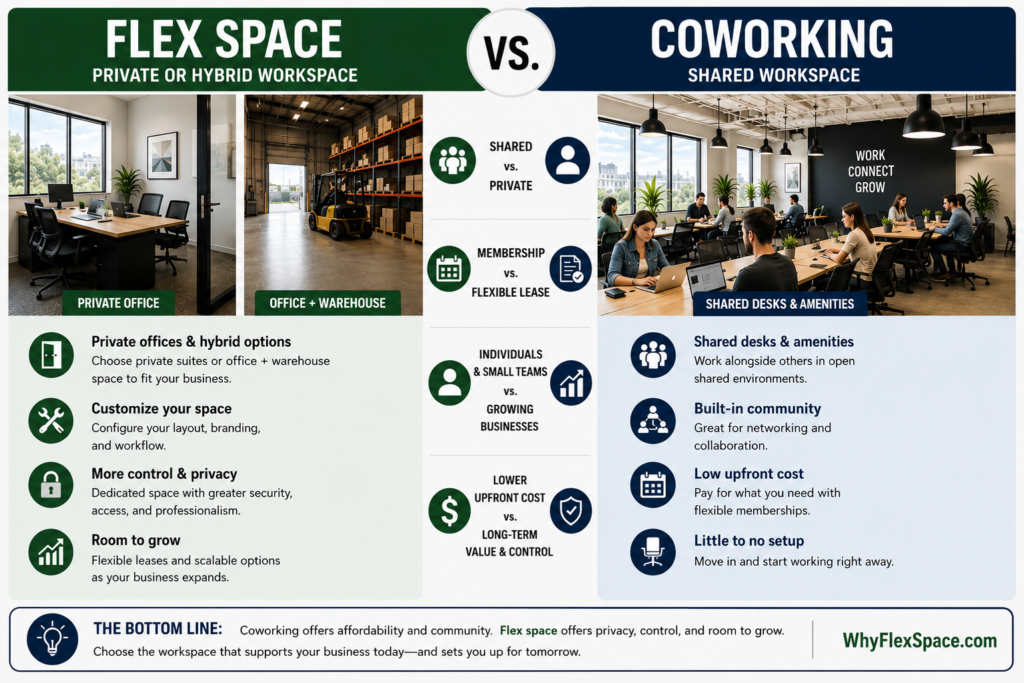
For most growing businesses, the decision comes down to this: coworking offers affordability and community, while flex space offers privacy, control, and room to grow.
What is coworking?
Coworking spaces are shared work environments where individuals, freelancers, and small teams rent desks or memberships rather than dedicated private offices. The defining feature is the communal setup — you’re working in the same room as people from other companies, sharing amenities like Wi-Fi, printers, kitchens, and conference rooms.
Coworking works well for solo operators, remote workers, and early-stage startups that need a professional environment and a sense of community without the cost of a private office.
What is flex space?
Flex space is a broader category that includes coworking but goes well beyond it. The defining characteristic of flex space isn’t the shared environment — it’s the flexibility of the lease and the adaptability of the layout. Flex space can include:
- Private suites — lockable offices for teams of any size, with dedicated space that isn’t shared with other companies
- Open plan offices — configurable layouts that can be adjusted as a team grows or shrinks
- Light industrial units — warehouse-style spaces with high ceilings, suitable for manufacturing, fabrication, or maker businesses
- Hybrid spaces — combinations of office and warehouse or light industrial areas under one roof
- Coworking areas — shared open-plan desking within a larger flex complex
Coworking vs. flex space at a glance
| Feature | Coworking | Flex Space |
|---|---|---|
| Privacy | Shared | Private or shared |
| Best for | Freelancers & small teams | Growing businesses & established teams |
| Lease | Membership | Short-term lease |
| Workspace | Shared desks | Dedicated suites |
| Warehouse space | No | Sometimes |
| Scalability | Limited | High |
Can your business outgrow coworking?
Many businesses begin in coworking because it’s inexpensive and easy to join. As they hire employees, meet with clients more often, or need greater privacy, they often transition into flex space. Flex space lets companies keep the flexibility they value while gaining dedicated offices and room to grow — which is also why you can start in coworking and move to flex space later without locking into a long-term lease upfront.
Which one should you choose?
Choose coworking if you:
- Work alone
- Need a desk, not an office
- Value networking
- Want the lowest monthly cost
Choose flex space if you:
- Need privacy
- Have employees
- Regularly meet with clients and need a private, professional environment
- Expect your business to grow
- Need office and warehouse space
Next steps
- Not sure how much office space you need? → Flex Space Calculator
- Want the full picture on planning your space? → Office Space Planning Guide
- New to flex space? → What Is Flex Space?
- Explore all guides, calculators, and resources → Resources Hub